

Introduction to Technology Analysis
Technology has become an essential part of modern life, influencing how people communicate, work, learn, shop, travel, and conduct business. From smartphones and cloud computing to artificial intelligence and advanced automation, digital innovations continue to change industries around the world. Understanding these changes requires careful observation, research, and evaluation. This is where technology analysis becomes valuable.
Technology analysis is the process of examining technological systems, products, tools, trends, and innovations to understand how they work, what benefits they offer, and what challenges they may create. It helps individuals and organizations make informed decisions about adopting new technologies, improving existing systems, and preparing for future developments.
As technology continues to advance, businesses must determine which innovations are worth investing in, consumers need to understand the tools they use, and professionals must keep their skills up to date. A structured approach to technology analysis can help all these groups identify opportunities, reduce risks, and understand the broader impact of digital transformation.
This article explores the meaning of technology analysis, its major methods, its importance in business, the role of artificial intelligence, cybersecurity considerations, emerging trends, and the future of technological development.
What Is Technology Analysis
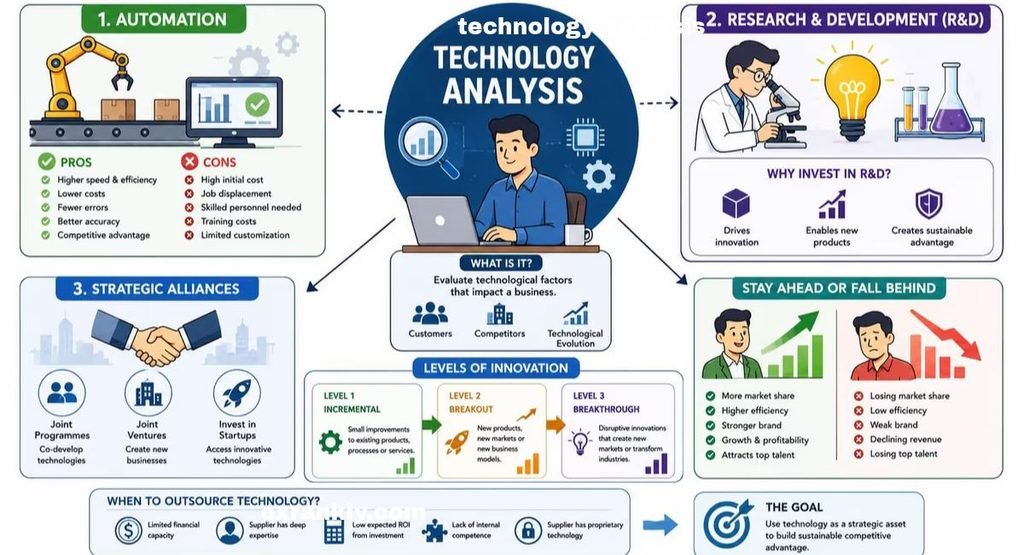
Technology analysis involves examining a technology’s capabilities, performance, costs, limitations, and potential effects. It can focus on a single product, an entire digital system, an emerging innovation, or a broader technological trend.
For example, a company considering new accounting software may compare its features, pricing, security measures, compatibility, and ease of use. A researcher studying artificial intelligence may examine its accuracy, training requirements, practical applications, and ethical implications. Both activities are examples of technology analysis because they evaluate technological options using relevant evidence.
The purpose is not simply to determine whether a technology is modern or popular. Instead, the objective is to understand whether it effectively solves a particular problem and provides meaningful value.
A useful analysis considers both immediate benefits and long-term consequences. A system may offer impressive performance but require expensive maintenance. Another solution may appear less advanced while providing greater reliability and lower operating costs.
Technology analysis therefore combines technical knowledge, practical experience, research, and critical thinking. It allows decision-makers to look beyond marketing claims and evaluate technology according to real needs.
Why Technology Analysis Is Important
Technology changes rapidly, and new products frequently promise better performance, greater convenience, or lower costs. Without careful evaluation, organizations and individuals may invest in solutions that fail to meet their expectations.
Technology analysis helps reduce uncertainty by identifying strengths, weaknesses, opportunities, and risks before decisions are made.
Better Decision-Making
One of the most important benefits of technology analysis is improved decision-making. Instead of choosing a product because it is popular, users can compare its capabilities with their actual requirements.
A small business, for instance, may need customer management software. By examining available options, the business can identify a system that fits its budget, supports its workflow, and can grow alongside the company.
This approach also helps prevent unnecessary spending on features that provide little practical value.
Improved Efficiency
Technology is frequently introduced to make processes faster and more accurate. However, not every new system automatically improves productivity.
Technology analysis helps determine whether a tool genuinely saves time, reduces errors, or simplifies complicated tasks. It can reveal where automation is useful and where human involvement remains essential.
When organizations understand how their systems perform, they can make targeted improvements instead of changing entire processes without sufficient evidence.
Reduced Risk
Every technological decision involves some level of risk. These risks may include cybersecurity threats, unexpected expenses, system failures, compatibility problems, and employee resistance.
A detailed analysis identifies potential problems before implementation. Organizations can then develop appropriate safeguards, backup plans, and training programs.
This preparation is particularly important when technology supports sensitive information, financial operations, customer services, or critical infrastructure.
Major Types of Technology Analysis
Technology analysis covers several different areas. The appropriate method depends on the technology being examined and the decision that needs to be made.
Technical Analysis
Technical analysis evaluates how a system works and whether it meets the required technical standards. Common considerations include processing speed, reliability, scalability, compatibility, and resource requirements.
For software, this might involve testing response times, examining error rates, and assessing how the application performs when many people use it simultaneously.
For hardware, the analysis may examine energy consumption, processing capabilities, durability, and operating conditions.
Technical analysis helps establish whether a technology can perform its intended function under realistic conditions.
Cost-Benefit Analysis
Cost-benefit analysis compares the expected expenses of a technology with the benefits it may provide.
The costs can include purchasing equipment, subscription fees, installation, employee training, maintenance, upgrades, and technical support. Benefits may include increased productivity, reduced operational expenses, improved customer experiences, and fewer errors.
For example, an automated inventory system may require an initial investment. However, it could reduce stock discrepancies and save employees several hours of manual work each week.
A thorough evaluation considers the total cost of ownership rather than focusing only on the initial purchase price.
Competitive Technology Analysis
Businesses often examine the technologies used by competitors to understand industry expectations and identify opportunities for improvement.
This process may involve comparing digital platforms, customer service tools, manufacturing systems, mobile applications, and data management practices.
The purpose is not simply to copy another company. Instead, competitive analysis helps organizations understand what works in their industry and where they can offer a better solution.
A company may discover that customers expect faster online support, more convenient payment options, or a smoother mobile experience. These findings can guide future technology investments.
Strategic Technology Analysis
Strategic analysis examines how technology supports long-term goals.
A business planning to expand internationally, for example, may need scalable cloud infrastructure, multilingual customer support, stronger data protection, and integrated payment systems.
Strategic technology analysis connects these requirements with the organization’s broader plans. It also helps decision-makers prioritize investments and avoid adopting disconnected tools that create unnecessary complexity.
The Role of Artificial Intelligence in Technology Analysis
Artificial intelligence has become an important part of modern technological development. AI systems can process large amounts of information, recognize patterns, generate content, support decision-making, and automate repetitive tasks.
These capabilities can improve technology analysis by helping researchers identify patterns that would be difficult to recognize manually.
For example, an organization can use AI-assisted analytics to examine system performance, identify unusual activity, summarize customer feedback, or estimate future demand. Engineers can also use intelligent tools to investigate errors and improve software development workflows.
Predictive Analytics
Predictive analytics uses historical information and statistical or machine-learning methods to estimate what may happen in the future.
In technology management, predictive models can help estimate equipment failures, identify potential performance problems, or forecast demand for digital services.
A manufacturing company may analyze sensor data to identify signs that a machine requires maintenance. Addressing the issue early could reduce downtime and repair costs.
However, predictions are not guarantees. Their quality depends on the data, assumptions, and methods used. Analysts must evaluate the reliability of predictions before using them to make important decisions.
Automation and Productivity
AI-powered automation can reduce the amount of time required for repetitive activities such as organizing information, classifying support requests, reviewing logs, and preparing preliminary reports.
This allows professionals to focus on interpretation, planning, and complex problem-solving.
Nevertheless, automated results still require appropriate oversight. AI systems can produce inaccurate information, misunderstand context, or reflect weaknesses in their training data.
Effective technology analysis combines automation with human judgment rather than assuming that every AI-generated result is correct.
Responsible Use of AI
AI adoption also raises questions about privacy, fairness, transparency, accountability, and employment.
Organizations should understand what information their systems collect, how decisions are generated, and who is responsible when an automated process causes harm.
A responsible technology analysis evaluates these issues alongside technical performance. This helps ensure that innovation serves users and organizations without ignoring broader social consequences.
Technology Analysis in Business and Industry
Technology influences nearly every major industry, but its practical applications vary depending on operational needs.
Technology Analysis in Healthcare
Healthcare organizations use digital records, diagnostic equipment, remote consultation platforms, and analytical tools to support medical services.
Technology analysis helps evaluate whether these systems are accurate, secure, accessible, and compatible with existing workflows.
For example, a hospital introducing a digital patient-record system must consider data protection, staff training, system availability, and integration with other medical applications.
The system must also support reliable information management without creating unnecessary administrative burdens.
Technology Analysis in Education
Educational institutions increasingly use digital classrooms, online learning platforms, educational applications, and AI-assisted learning tools.
Technology analysis can help teachers and administrators determine whether these solutions improve access to educational resources and support student learning.
Important factors include ease of use, accessibility, affordability, privacy, and compatibility with different devices.
A successful educational technology solution should support teaching objectives rather than introduce digital tools simply because they are available.
Technology Analysis in Finance
Financial organizations depend on secure digital systems for payments, account management, fraud detection, and financial reporting.
Technology analysis helps evaluate transaction speed, reliability, data security, regulatory requirements, and customer convenience.
For example, a digital payment provider must ensure that its platform can process transactions efficiently while protecting users from unauthorized access.
Even a technically advanced financial platform can fail if it creates confusing experiences or exposes sensitive information.
Technology Analysis in Retail and E Commerce
Retail businesses use technology for inventory management, personalized recommendations, online payments, customer support, and sales forecasting.
Analyzing these systems can reveal opportunities to improve the shopping experience and reduce operational costs.
An online store might evaluate its checkout process to determine why customers abandon purchases before completing payment. The analysis could identify slow loading times, unclear shipping charges, or unnecessary form fields as contributing factors.
Addressing these problems can improve usability and help the business serve customers more effectively.
The Importance of Data in Technology Analysis
Data provides the evidence needed to evaluate technological performance. Without reliable information, analysts may rely too heavily on assumptions, personal opinions, or promotional claims.
Useful data can include system logs, customer surveys, performance measurements, error reports, usage statistics, financial records, and controlled test results.
The quality of the analysis depends partly on the quality of the information being examined.
Collecting Relevant Data
The first step is identifying which information directly relates to the problem.
If a company wants to improve website performance, useful measurements may include page-loading times, server response times, error rates, and user behavior.
Collecting large amounts of unrelated data can make analysis more complicated without improving the final decision.
Clear objectives help analysts focus on the most relevant measurements.
Interpreting Results
Data must be interpreted in context. A rise in website traffic, for example, may indicate increased interest, but it does not necessarily mean that sales or customer satisfaction have improved.
Similarly, faster software may not provide meaningful benefits if it becomes less reliable or harder to use.
Analysts should compare several relevant measurements and investigate unexpected results before reaching conclusions.
Protecting Data Privacy
Data collection introduces privacy and security responsibilities. Organizations should collect only the information they need, restrict access appropriately, and follow applicable data protection requirements.
Sensitive information should be handled carefully throughout collection, storage, analysis, and disposal.
Responsible data management protects users while supporting more trustworthy technology decisions.
Cybersecurity and Technology Analysis
Cybersecurity is a central part of evaluating any modern digital system. As organizations rely increasingly on connected platforms, protecting systems and information becomes essential.
Technology analysis can help identify weaknesses in networks, software, devices, user permissions, and operational procedures.
Identifying Security Vulnerabilities
Security assessments examine potential weaknesses that attackers could exploit. These may include outdated software, weak passwords, excessive account permissions, insecure configurations, and insufficient monitoring.
Organizations should regularly review their systems and prioritize vulnerabilities according to their potential impact.
A security assessment should also examine how different components interact because a weakness in one system may affect the wider network.
Evaluating Security Measures
Security technologies include multifactor authentication, encryption, access controls, endpoint protection, monitoring tools, and backup systems.
Technology analysis helps determine whether these controls are appropriate for the organization’s risks.
For example, multifactor authentication can reduce the danger associated with stolen passwords, while reliable backups can support recovery after accidental deletion, hardware failure, or ransomware incidents.
No single security measure eliminates every threat. Effective protection requires several complementary controls and ongoing review.
Preparing for Future Threats
Cybersecurity threats continue to change as attackers develop new techniques and organizations adopt new technologies.
Regular technology analysis helps businesses review their defenses, identify emerging risks, and update their security plans.
Employees also need practical security training because human mistakes can create vulnerabilities even when technical safeguards are strong.
Cloud Computing and Digital Infrastructure
Cloud computing allows organizations to access computing resources, software, and storage through network-based services rather than managing every component locally.
It can provide flexibility, support remote work, and make it easier to increase computing capacity when demand grows.
However, cloud adoption requires careful evaluation.
Organizations should examine service reliability, pricing structures, data location, access controls, backup arrangements, and the difficulty of moving information to another provider.
A service that appears inexpensive initially may become costly as storage, data transfers, or usage increase.
Scalability and Flexibility
Scalability describes a system’s ability to handle changing workloads. Cloud services can allow organizations to expand or reduce resources according to demand.
For example, an online store may experience increased traffic during a major sale. Scalable infrastructure can help maintain performance during these busy periods.
Technology analysis determines whether the proposed infrastructure can handle expected workloads without unnecessary spending.
Reliability and Recovery
Digital services need plans for outages, data loss, and unexpected disruptions.
Analysts should examine service-level commitments, backup frequency, recovery procedures, and dependencies on external providers.
Businesses should also test their recovery plans instead of assuming that a backup system will always work when needed.
Emerging Trends Shaping Technology Analysis
Several developments are changing how organizations evaluate and adopt technology.
Internet of Things
The Internet of Things, commonly known as IoT, connects physical devices that collect or exchange information through networks.
Examples include smart thermostats, industrial sensors, connected vehicles, and equipment-monitoring systems.
Technology analysis can evaluate the reliability, security, energy consumption, and practical value of these devices.
Organizations must also consider how connected devices will be maintained and updated throughout their operational lives.
Edge Computing
Edge computing processes information closer to where it is generated instead of sending every piece of data to a distant centralized system.
This approach can reduce delays and support applications that require rapid responses.
For example, industrial equipment may need to respond immediately to sensor readings. Processing certain information locally can improve responsiveness.
However, edge computing may introduce additional maintenance, security, and infrastructure requirements. The right approach depends on the application.
Automation and Robotics
Robotics and automation are transforming manufacturing, logistics, agriculture, and other industries.
Automated systems can perform repetitive tasks consistently, assist with dangerous work, and improve production efficiency.
Technology analysis helps determine whether automation is suitable for a specific task, considering equipment costs, safety, maintenance, training, and expected productivity improvements.
It should also consider how employees will work alongside automated systems and which new skills they may need.
Green Technology
Environmental sustainability is becoming an important consideration in technology decisions.
Organizations are evaluating energy-efficient equipment, renewable energy systems, improved cooling methods, recyclable materials, and longer-lasting devices.
Technology analysis can compare the environmental effects of different solutions over their lifecycles.
A device that consumes less electricity may reduce operating expenses, while equipment that lasts longer may reduce electronic waste.
However, environmental assessments should consider manufacturing, transportation, energy use, maintenance, and disposal rather than focusing on a single factor.
How to Conduct Effective Technology Analysis
A structured process makes technology evaluation more consistent and useful.
Define the Objective
Begin by identifying the problem or opportunity. Determine what the organization wants to improve and why the change matters.
A clear objective might be reducing customer-support response times, improving website reliability, or protecting confidential information.
Without a defined objective, it becomes difficult to determine whether a technology is successful.
Gather Information
Research available solutions, technical specifications, costs, implementation requirements, and user experiences.
Use reliable evidence and distinguish verified facts from assumptions or marketing claims.
Where possible, evaluate information from several independent sources.
Establish Evaluation Criteria
Choose the measurements that matter most to the decision.
These may include cost, reliability, security, performance, accessibility, scalability, usability, and environmental impact.
Assigning priorities to these criteria can help compare alternatives fairly.
Compare Available Solutions
Evaluate each option against the same requirements.
A comparison table can make differences easier to understand and reveal which features provide genuine value.
It is also useful to identify disadvantages, hidden costs, and limitations rather than concentrating only on benefits.
Test Before Implementation
Whenever possible, conduct a pilot project or controlled test before adopting a technology across an entire organization.
Testing can reveal compatibility issues, training needs, performance problems, and unexpected expenses.
A limited trial also gives employees an opportunity to provide feedback before a large investment is made.
Measure Results
After implementation, compare actual performance with the original objectives.
For example, a business introducing automated customer support might measure response time, resolution rates, customer satisfaction, and the frequency of incorrect answers.
These measurements help determine whether the investment delivered its intended benefits.
Review and Improve
Technology analysis should continue after a system is introduced.
Business needs change, software becomes outdated, security risks evolve, and better solutions may become available.
Regular reviews help organizations maintain performance and decide when upgrades or replacements are justified.
Challenges in Technology Analysis
Although technology analysis offers many benefits, the process can be difficult.
Rapid Technological Change
New products and standards can appear before organizations have fully evaluated existing solutions.
Decision-makers may struggle to determine whether an innovation is mature enough for practical use or whether waiting would provide better value.
A balanced approach considers both the advantages of early adoption and the risks of investing too soon.
Limited Budgets
Small businesses may not have enough money or specialist staff to conduct extensive technical assessments.
They can address this challenge by prioritizing high-impact decisions, using available trial versions, consulting independent reviews, and testing solutions on a limited scale.
The depth of the analysis should match the importance and risk of the decision.
Information Overload
The large volume of available technical information can make comparisons difficult.
Specifications may use different measurement methods, and product claims may emphasize strengths while overlooking limitations.
Analysts should focus on decision-relevant evidence and use consistent criteria when comparing alternatives.
Skills and Expertise
Some technologies require specialist knowledge to evaluate correctly.
Cybersecurity, machine learning, cloud architecture, and advanced data systems may involve technical issues that general users cannot easily assess.
Organizations should recognize these limitations and involve qualified professionals when necessary.
The Future of Technology Analysis
Technology analysis will remain important as digital systems become more powerful and interconnected.
Artificial intelligence may help analysts process information faster, detect unusual patterns, and automate parts of the evaluation process. Meanwhile, improved monitoring systems may provide more detailed evidence about how technologies perform in real-world environments.
Future assessments are also likely to pay greater attention to privacy, environmental sustainability, transparency, and responsible innovation.
Organizations will need to evaluate not only whether a technology works, but also whether it is trustworthy, maintainable, affordable, and appropriate for the people who use it.
Another important development is the growing connection between technical performance and business strategy. Technology decisions increasingly influence customer experience, workforce planning, competitiveness, and long-term resilience.
As a result, effective technology analysis will require collaboration between technical specialists, managers, security professionals, designers, and end users.
The strongest evaluations will combine measurable evidence with an understanding of human needs and organizational priorities.
How Individuals Can Benefit from Technology Analysis
Technology analysis is useful not only for large companies but also for everyday consumers and professionals.
Before purchasing a smartphone, a person can compare battery life, software support, camera performance, durability, and price. Before subscribing to a digital service, they can examine its privacy practices, available features, and cancellation terms.
Students can use technology analysis to evaluate educational applications, research tools, and online learning platforms. Professionals can use it to decide which skills, software packages, or certifications are worth pursuing.
Developing these habits encourages critical thinking and reduces the likelihood of making decisions based solely on advertising or social media trends.
Individuals should also learn to recognize unreliable information, question exaggerated claims, and distinguish genuine technical improvements from features that offer little practical benefit.
A thoughtful approach to technology makes it easier to choose tools that support personal goals, improve productivity, and provide lasting value.
Technology Analysis and Business Innovation
Innovation involves developing new ideas, products, services, or processes that create value. Technology analysis supports innovation by helping organizations understand which opportunities are realistic and which problems need further investigation.
Before developing a new digital product, a business can research customer needs, examine competing solutions, assess technical feasibility, and estimate development costs.
This process can identify gaps in the market and prevent teams from spending resources on products that customers do not need.
Technology analysis can also improve existing products by examining user feedback, performance data, and recurring technical problems.
For example, a software company may discover that customers frequently struggle with account setup. A detailed assessment could lead to a simpler onboarding process, clearer instructions, and fewer support requests.
Innovation does not always require creating an entirely new technology. Sometimes, the greatest improvements come from applying existing tools more effectively.
Conclusion
Technology analysis is an essential process for understanding digital innovation, evaluating technical solutions, and making informed decisions in a rapidly changing world. It helps individuals and organizations examine performance, costs, security, usability, scalability, and long-term value before committing resources to new technologies.
From artificial intelligence and cloud computing to cybersecurity, healthcare, education, and online retail, technology analysis supports better planning and more responsible adoption. It also helps organizations recognize potential risks, identify opportunities for improvement, and measure whether technological investments achieve their intended goals.
An effective approach combines reliable data, clear objectives, consistent evaluation criteria, practical testing, and continuous improvement. It recognizes that even an advanced technology may not be suitable for every situation and that successful implementation requires attention to people, processes, and organizational needs.
As digital innovation continues to develop, technology analysis will remain valuable for businesses, professionals, students, and consumers. By examining evidence carefully and focusing on practical outcomes, people can make better technological choices, adapt to emerging trends, and prepare for future opportunities.
Ultimately, the purpose of technology analysis is not simply to understand what technology can do. It is to determine how technology can be used effectively, securely, responsibly, and sustainably to solve real problems and create meaningful value.




Pingback: How New Technology Impact Human Computer Interaction A Complete Guide to Modern Digital Experiences - oxrankly.com
Pingback: Technology Improvement How Modern Innovations Are Transforming Everyday Life and the Future - oxrankly.com