

Introduction to Common Spanish Women’s Names
Choosing a name is an important decision that can influence how a person expresses their identity and connects with their cultural background. Spanish names are especially interesting because they combine centuries of history, religious traditions, regional influences, and modern naming trends. From timeless classics such as María and Carmen to contemporary favorites such as Lucía and Valeria, there are many beautiful names to explore.
When researching common spanish women’s names, it is helpful to understand that Spanish naming traditions extend beyond Spain itself. Spanish is spoken across many countries, including Mexico, Colombia, Argentina, Peru, Chile, and numerous other communities throughout Latin America. Although these regions share the Spanish language, their naming preferences can differ according to local customs, family traditions, and cultural influences.
Some Spanish female names have remained popular for generations, while others have become fashionable more recently. Certain names are associated with religious traditions, whereas others are inspired by nature, historical figures, or qualities such as strength, beauty, and wisdom.
This guide explores popular Spanish women’s names, their meanings, traditional origins, modern variations, and cultural significance. Whether someone is choosing a name for a baby, researching Spanish culture, developing a fictional character, or simply discovering beautiful names, understanding these options can make the process more enjoyable.
What Makes Spanish Women’s Names Special

Spanish women’s names have a distinctive charm because of their pronunciation, historical roots, and cultural importance. Many names contain soft vowel sounds and flowing syllables, making them pleasant to pronounce in Spanish and several other languages.
For example, names such as Elena, Isabella, Sofia, and Camila are familiar internationally. They are relatively easy to recognize and have variations in other languages. This international familiarity has helped many Spanish names become popular far beyond Spanish-speaking countries.
Another important characteristic is the influence of family traditions. Parents may choose a name to honor a grandmother, mother, religious figure, or another respected family member. In some families, a traditional name is passed from one generation to the next, preserving a connection with the past.
Spanish naming customs also include compound first names. María José, María Isabel, and Ana María are examples of combinations that bring together two familiar names. These combinations may reflect religious devotion, family heritage, or personal preference.
The variety of common spanish women’s names means that parents and researchers can find options suited to different tastes. Some prefer short and simple names, while others appreciate longer, elegant combinations with historical significance.
The Most Popular Spanish Women’s Names
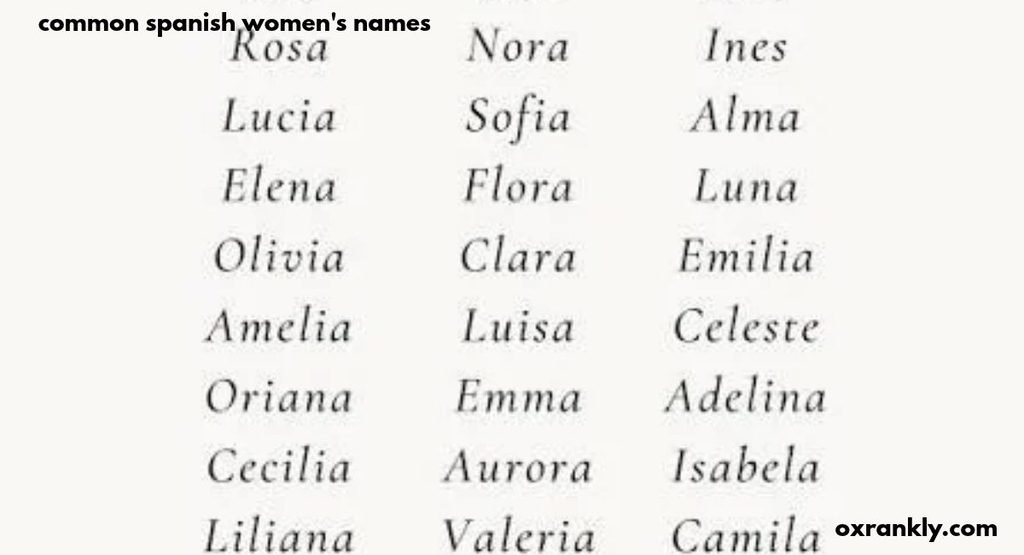
The following names are widely recognized in Spanish-speaking communities. Popularity varies by country and generation.
María
María is one of the most enduring names in Spanish-speaking cultures. It comes from the Latin form of the Greek name Maria, associated with the Hebrew name Miriam. Its precise original meaning is debated, although it has strong religious significance in Christian traditions.
The name appears in countless compound names, including María José, María Carmen, and María Isabel. Its historical importance and familiar pronunciation have helped it remain a classic choice for generations.
Carmen
Carmen is a traditional Spanish feminine name with deep cultural associations. It is often connected with devotion to Our Lady of Mount Carmel. The name is also associated with the Spanish literary and musical tradition through the famous opera Carmen.
Its strong sound and distinctive character make it appealing to families who appreciate traditional Spanish names. Carmen remains recognizable in Spain and internationally.
Lucía
Lucía comes from the Latin word lux, meaning light. Its meaning gives the name a bright and positive association. The accent on the í indicates the correct Spanish pronunciation, with emphasis on the final syllable.
Lucía is particularly attractive to parents seeking a name that feels both traditional and contemporary. Its short length, gentle sound, and clear meaning contribute to its popularity.
Sofía
Sofía is the Spanish form of Sophia, a name derived from the Greek word for wisdom. It has a graceful sound and an internationally recognizable spelling.
The name is popular among families who prefer elegant names that work well across languages. It can also be spelled Sofia without an accent in some languages and naming systems.
Isabel
Isabel is a long-established Spanish name related to Elizabeth and its historical forms. It has appeared in royal families, literature, and European history.
Its classic sound makes it suitable for people who appreciate traditional names without choosing a particularly long or complicated option. Isabel also offers affectionate nicknames such as Isa and Bel.
Ana
Ana is the Spanish form of Anna, traditionally associated with the Hebrew name Hannah and the meaning grace or favor. It is simple, familiar, and easy to pronounce.
Ana frequently appears in compound names, including Ana María and Ana Isabel. Its simplicity is one of its strongest qualities.
Paula
Paula is the feminine form of Paul, derived from a Latin word meaning small or humble. It has a modern, friendly sound while retaining a long historical background.
The name is recognizable throughout Spain and Latin America and works well in multilingual families.
Valeria
Valeria comes from the Latin family of names associated with strength and health. Its energetic pronunciation gives it a confident and elegant character.
Valeria is a useful option for parents who want a name that feels fashionable while still having classical roots.
Martina
Martina is the feminine form of Martin, a name connected with the Roman god Mars. It has a strong historical background and a melodic Spanish pronunciation.
The name is familiar across several Spanish-speaking countries and has gained attention among families who enjoy traditional names with a contemporary feel.
Elena
Elena is a form of Helen, traditionally associated with light or brightness. It has a long history across Europe and is widely recognized in Spanish-speaking communities.
Its balanced pronunciation and classic style make Elena an appealing choice for people seeking a timeless feminine name.
Traditional Spanish Women’s Names
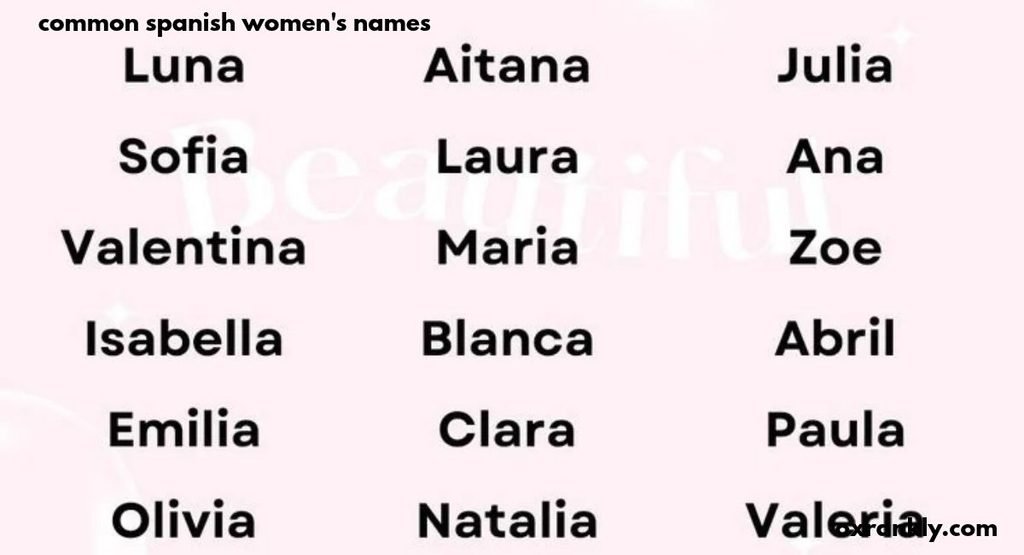
Traditional names are especially meaningful because they preserve historical and cultural connections. Many have been used for centuries and continue to appear in families today.
Here are more traditional names to consider:
| Name | Commonly associated meaning or origin |
|---|---|
| Teresa | Traditionally associated with the name Teresa; its original meaning is uncertain |
| Dolores | Sorrows; associated with Marian devotion |
| Pilar | Pillar; associated with Our Lady of the Pillar |
| Rosario | Rosary; connected with Catholic tradition |
| Concepción | Conception; associated with the Immaculate Conception |
| Mercedes | Mercies; connected with religious devotion |
| Remedios | Remedies or relief |
| Amparo | Protection or shelter |
| Ángeles | Angels |
| Soledad | Solitude; associated with Marian devotion |
| Josefa | Feminine form of José |
| Francisca | Feminine form of Francisco |
| Antonia | Feminine form of Antonio |
| Beatriz | Traditionally associated with happiness or blessedness |
| Catalina | Spanish form of Katherine |
These names may sound particularly traditional to younger Spanish speakers, although their popularity varies significantly across generations and regions. Some families choose them to honor older relatives, while others appreciate their historical meaning.
Pilar, Teresa, and Beatriz can offer a classic style without requiring a compound first name. Dolores, Rosario, and Concepción have especially strong connections with Spanish Catholic traditions.
Traditional names also demonstrate that naming customs are not static. A name that was extremely common among grandmothers may become less frequent among newborns and later return to fashion.
Modern and Stylish Spanish Women’s Names
Modern naming preferences often favor names that are short, melodic, internationally recognizable, or associated with positive qualities. Many contemporary choices still have ancient origins.
Valentina
Valentina comes from the Latin name Valentinus and is associated with strength and health. It is a romantic-sounding name used in Spain and many Latin American countries.
Emma
Emma is a name of Germanic origin that has become popular internationally, including in Spanish-speaking communities. Its short spelling and straightforward pronunciation make it easy to use across languages.
Martina
Martina combines a classical background with a fresh, contemporary style. It is suitable for families who want a name that feels established but not overly formal.
Alma
Alma means soul in Spanish. This simple word name has an appealing meaning and a gentle sound. It is especially attractive to people who prefer meaningful names with only a few letters.
Vega
Vega is a Spanish surname and given name associated with a fertile meadow. It is also the name of a bright star, giving it an additional astronomical association.
Abril
Abril is the Spanish word for April. As a given name, it has a fresh, seasonal quality and is particularly distinctive for people who appreciate nature-inspired names.
Aitana
Aitana is associated with the Aitana mountain range in Spain. It has a distinctly Spanish character and is often chosen by families looking for something less conventional than María or Ana.
Noa
Noa is a short name used in Spanish-speaking communities. Its background can vary according to the linguistic and cultural tradition in which it is used.
Chloe
Chloe has Greek origins and is associated with young green growth. It is used internationally and appears in modern Spanish-speaking naming choices, although its popularity differs between countries.
Olivia
Olivia is widely used internationally and is also familiar in Spanish-speaking communities. It is commonly associated with the olive tree, which symbolizes peace in several traditions.
These examples illustrate how modern Spanish naming choices can combine local identity with international influences.
Beautiful Spanish Women’s Names and Their Meanings
Many people begin their search by looking for names with beautiful meanings. Spanish offers a wide range of names associated with light, love, nature, happiness, and strength.
| Name | Meaning or association |
|---|---|
| Clara | Clear or bright |
| Blanca | White |
| Estrella | Star |
| Luna | Moon |
| Esperanza | Hope |
| Felicidad | Happiness |
| Paloma | Dove |
| Rocío | Dew |
| Marisol | A traditional Spanish name with varied interpretations |
| Aurora | Dawn |
| Flor | Flower |
| Rosa | Rose |
| Marina | Of the sea |
| Sol | Sun |
| Perla | Pearl |
| Gloria | Glory |
| Inés | Spanish form of Agnes, traditionally associated with purity |
| Celia | A Latin-derived name with several historical interpretations |
| Diana | Roman goddess of the hunt and nature |
| Natalia | Traditionally associated with birth and Christmas |
These names appeal to different tastes. Luna, Sol, and Estrella are closely associated with the natural world and the sky. Esperanza and Gloria convey positive ideas, while Clara and Aurora suggest brightness.
Paloma and Rosa have especially familiar nature-related meanings. Marina is an attractive choice for families who feel a connection with the sea, while Perla offers a precious-gem association.
It is worth remembering that the meaning of a name is only one part of its appeal. Pronunciation, family history, cultural significance, and personal preference can be just as important.
Spanish Women’s Names Used Across Latin America
Spanish-speaking Latin America is culturally diverse, and naming preferences vary by country. A name that is especially fashionable in Argentina may have a different level of popularity in Mexico or Colombia.
Nevertheless, several names are widely recognizable across the region.
Mexico: María, Guadalupe, Fernanda, Valeria, Camila, Daniela, and Ximena are familiar names. Guadalupe has a particularly important religious and cultural association in Mexico.
Colombia: Valentina, Mariana, Daniela, Isabella, Luciana, and María José are recognizable choices. Preferences can vary between cities and generations.
Argentina: Sofía, Martina, Valentina, Emilia, Catalina, and Lucía are well-known names. Italian and other European influences also contribute to Argentina’s broader naming culture.
Chile: Emilia, Sofía, Isidora, Florencia, and Julieta are examples of names familiar in Chilean society.
Peru: María, Camila, Valeria, Daniela, and Luciana are recognizable choices, alongside many traditional and compound names.
These are illustrative examples rather than an official ranking. Exact popularity depends on the year, location, and whether the data refers to newborn registrations or the entire population.
The regional variety makes common spanish women’s names an interesting subject for people researching family heritage, language, and cultural identity.
Spanish Compound Names for Girls
Compound names are an important part of Spanish naming traditions. They combine two names into a single given-name choice, sometimes preserving a religious or family connection.
Some well-known examples include:
María José: Combines María and José, creating a familiar traditional name.
Ana María: A classic combination with a gentle, balanced sound.
María Isabel: Brings together two established names.
María Carmen: A traditional combination associated with Spanish naming customs.
María Teresa: A long-standing combination with a formal, timeless quality.
María Fernanda: Combines a traditional name with a name associated with courage and travel through its Germanic roots.
Ana Sofía: Pairs a simple classic name with one associated with wisdom.
María Elena: A combination of two widely recognized feminine names.
Ana Paula: A short, harmonious combination.
Luz María: Combines Luz, meaning light, with María.
The two names may be written separately, and the way they are used can differ from one family or country to another. Some people consistently use both names, while others use only one in everyday conversation.
Compound names can also be useful when parents want to honor two relatives without choosing only one family name.
Short and Easy-to-Pronounce Spanish Women’s Names
Short names are popular with people who prefer simplicity. They can be easy to spell, convenient in everyday communication, and suitable for use in multiple languages.
Consider these options:
Ana: Grace or favor through its historical roots.
Eva: The Spanish form of Eve.
Luz: Light.
Sol: Sun.
Alma: Soul.
Inés: A Spanish form of Agnes.
Iris: Associated with the rainbow and Greek mythology.
Noa: A short, contemporary choice.
Rosa: Rose.
Vera: A name with several linguistic histories, including associations with truth in some traditions.
Elsa: A form related to Elizabeth.
Mara: A name with different meanings and origins across cultures.
Short names are often attractive to multilingual families because they can be easier for speakers of different languages to remember. However, Spanish accents and pronunciation rules still matter. For instance, the accent in Inés changes how the word is pronounced and written.
A short name can also be paired with a longer middle name. Ana Lucía, Eva María, and Alma Sofía demonstrate how a simple first name can work with a more elaborate combination.
Spanish Women’s Names Inspired by Nature
Nature-inspired names can reflect a family’s appreciation for flowers, landscapes, seasons, and the sky.
Luna means moon and has a gentle, modern feel. Estrella means star and is a more expressive choice. Aurora means dawn, making it suitable for someone who likes names associated with new beginnings.
Flor means flower, while Rosa means rose. Both have a long history as feminine names. Violeta refers to the violet flower and offers a more elaborate alternative to Flor.
Marina is associated with the sea, and Paloma means dove. These names can be especially appealing to families who value peaceful or natural imagery.
Rocío, meaning dew, has a distinct Spanish identity and is also associated with religious tradition in parts of Spain. Abril, meaning April, evokes springtime in the Northern Hemisphere, although seasons differ across Spanish-speaking countries.
Nature-inspired names demonstrate how everyday Spanish vocabulary can become part of personal identity. They often carry symbolic associations that make them memorable beyond their literal meanings.
Spanish Women’s Names Associated With Strength and Confidence
Some parents prefer names that convey strength, resilience, courage, or independence. A name’s associations can develop through its linguistic roots, historical use, and the achievements of notable people who bear it.
Valeria is associated with strength and health through its Latin roots. Valentina has a related origin and is often interpreted through similar ideas of strength and vitality.
Victoria means victory. Its direct meaning gives it a confident and optimistic character.
Leonor is a traditional Spanish name with a royal and historical presence. Its original etymology is debated, so it is best appreciated for its history rather than assigned a definite literal meaning.
Alejandra is the Spanish feminine form of Alexander, a Greek-derived name traditionally associated with defending or protecting people.
Gabriela is the feminine form of Gabriel and is traditionally interpreted as “God is my strength” in its Hebrew-derived meaning.
Andrea has Greek roots and historical associations with bravery and masculinity through its original linguistic elements. Its use and gender associations vary between languages.
Jimena is a well-established Spanish feminine name with historical associations in the Iberian Peninsula. Its exact origin and meaning are debated.
These examples demonstrate that a confident name does not have to sound aggressive or unusual. Some of the most familiar names carry meaningful histories that have helped them endure across generations.
Religious and Historical Influences on Spanish Women’s Names
Religion has played a significant role in Spanish naming traditions, particularly through Catholicism. Names connected with Mary, saints, religious celebrations, and revered figures became established throughout Spain and Latin America.
María is the clearest example. It appears independently and in many compound names. Guadalupe is associated with Our Lady of Guadalupe, a major figure in Mexican Catholic devotion. Carmen is connected with Our Lady of Mount Carmel, while Pilar has a strong association with Our Lady of the Pillar in Spain.
Dolores, Concepción, Rosario, and Soledad also reflect Marian titles and religious traditions. These names can communicate family devotion, cultural continuity, and respect for earlier generations.
Historical and royal figures have also influenced naming preferences. Isabel, Leonor, and Catalina have appeared in European royal and noble families. Their use in history and literature has helped maintain their recognizable status.
However, not everyone chooses a name for religious reasons. Many people select traditional names because they like the sound, admire a historical figure, or want to preserve a family connection.
Understanding these influences provides useful context when exploring common spanish women’s names. It shows how naming practices reflect both individual preference and wider social history.
How to Choose the Right Spanish Women’s Name
Choosing a name can be easier when you consider a few practical questions.
Consider the Meaning
Think about whether you prefer a name associated with wisdom, hope, strength, nature, or another quality. Sofía, Esperanza, Valeria, and Aurora offer different symbolic associations.
Think About Pronunciation
Consider how the name sounds in Spanish and in any other languages spoken by the family. Lucía, Inés, and Sofía include accent marks that affect spelling and pronunciation.
Consider Family Traditions
A traditional name can honor a grandparent or another important relative. Compound names may help families preserve two meaningful connections.
Explore Regional Differences
If the name is intended for use in a particular country, consider local naming customs. A familiar name in Spain may have a different cultural association elsewhere in Latin America.
Decide Whether You Prefer Classic or Modern
María, Carmen, and Isabel have long histories, while names such as Aitana, Vega, and Abril may appeal to people looking for a more distinctive style. Both traditional and modern options can be meaningful.
Check the Full Name
Say the first name alongside the surname and any middle names. Consider spelling, rhythm, initials, and whether the complete name is easy to use in daily life.
Ultimately, the best name is one that feels right to the people choosing it. Popularity lists can provide inspiration, but they do not have to determine the final decision.
Frequently Asked Questions About Common Spanish Women’s Names
What are the most common Spanish women’s names
María, Carmen, Ana, Isabel, Lucía, Sofía, Elena, and Paula are widely recognized Spanish feminine names. However, the most common names differ depending on the country, age group, and year being studied.
What is a traditional Spanish female name
María is one of the most recognizable traditional Spanish feminine names. Other examples include Carmen, Teresa, Pilar, Dolores, Rosario, and Isabel.
What are some modern Spanish girl names
Valeria, Valentina, Martina, Lucía, Alma, Aitana, Vega, Abril, and Olivia are examples of names that appeal to contemporary naming preferences. Their popularity varies by region.
Which Spanish women’s names have beautiful meanings
Popular choices include Lucía, associated with light; Sofía, associated with wisdom; Esperanza, meaning hope; Clara, meaning clear or bright; and Aurora, meaning dawn.
Are Spanish names used in Latin America
Yes. Spanish is spoken across much of Latin America, and many names are shared between Spain and Latin American countries. Local traditions, migration, and cultural influences create differences in naming preferences.
What are some short Spanish female names
Ana, Eva, Luz, Sol, Alma, Inés, Noa, Rosa, and Iris are examples of short feminine names used in Spanish-speaking communities.
Why do some Spanish women have two first names
Compound names can preserve religious traditions, honor family members, or reflect long-standing cultural customs. Examples include Ana María, María José, and María Isabel.
Do Spanish names always have Spanish origins
No. Spanish naming traditions include names derived from Latin, Greek, Hebrew, Germanic languages, and other sources. A name can become firmly established in Spanish culture even when its earliest roots come from another language.
Conclusion
Common spanish women’s names reflect the history, language, and cultural diversity of Spanish-speaking communities. From the enduring popularity of María, Carmen, and Isabel to the contemporary appeal of Lucía, Valeria, and Alma, these names offer a wide range of styles and meanings.
Traditional names often preserve family and religious connections, while modern choices may emphasize simplicity, international recognition, or distinctive sounds. Nature-inspired options such as Luna, Rosa, and Estrella provide another source of inspiration, and compound names such as Ana María and María José demonstrate the importance of naming traditions.
There is no single name that is best for everyone. The right choice depends on personal taste, pronunciation, family background, and the meaning a name holds for the people using it. Exploring the many options available can help parents, writers, researchers, and anyone interested in Spanish culture discover a name that feels both meaningful and memorable.
Whether you prefer a timeless classic, a modern favorite, or a name connected with nature and history, Spanish naming traditions offer an abundance of possibilities to explore.




Pingback: How Much Do Caddies Earn A Complete Guide to Golf Caddie Salaries Tips and Earnings - oxrankly.com