

Introduction
Have you ever come across the word what is helonium mean and wondered what it actually refers to? At first glance, helonium sounds like the name of a chemical element, a special material, or even something from a science-fiction story. However, its meaning is connected to an interesting area of chemistry and astronomy.
Helonium is a name associated with the helium hydride ion, which has the chemical formula HeH⁺. This unusual molecular ion consists of helium and hydrogen and carries a positive electrical charge. Although the name might sound complicated, its basic meaning is relatively easy to understand when its chemical components are explained.
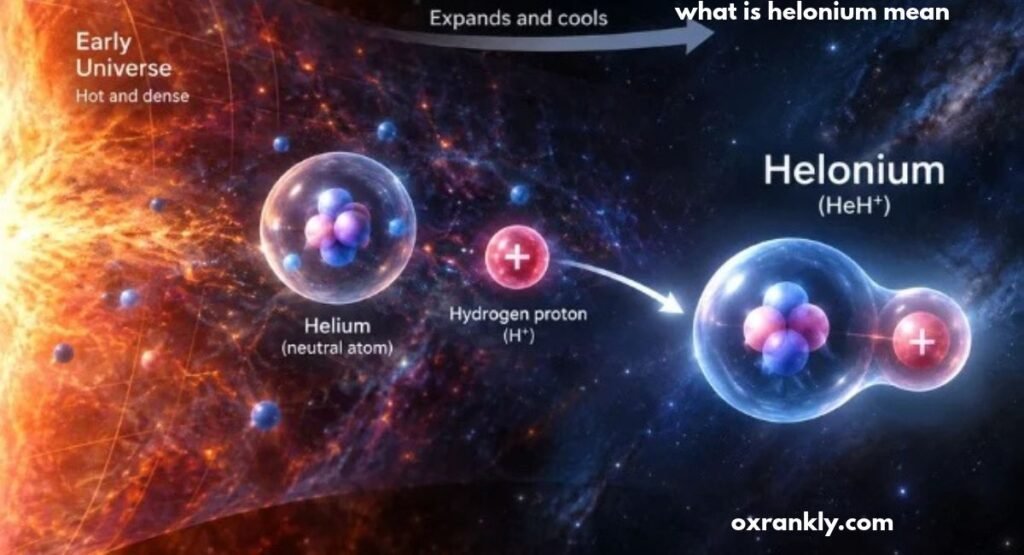
One reason helonium attracts attention is its connection to the early universe. Scientists believe that helium hydride ions played an important role in the development of early cosmic chemistry. Studying this molecule helps researchers understand how the first chemical bonds formed after the Big Bang and how increasingly complex molecules eventually became possible.
Another interesting fact is that helonium is not a separate chemical element. It does not have its own position on the periodic table like helium, oxygen, or hydrogen. Instead, it describes a particular combination of atomic components.
In this article, we will explore what is helonium mean, how it is formed, what its chemical formula represents, why scientists study it, and how it is connected to the history of the universe. We will also explain common misunderstandings and answer frequently asked questions in simple language.
What Is Helonium Mean
The term helonium refers to the helium hydride ion, commonly represented by the chemical formula HeH⁺. It is a positively charged molecular ion formed when a helium atom bonds with a hydrogen nucleus, which is essentially a proton.
To understand this definition, it helps to look at the two elements involved. Helium is a chemical element known for being a very light and chemically unreactive noble gas. Hydrogen is the lightest chemical element and contains one proton in its most common form.
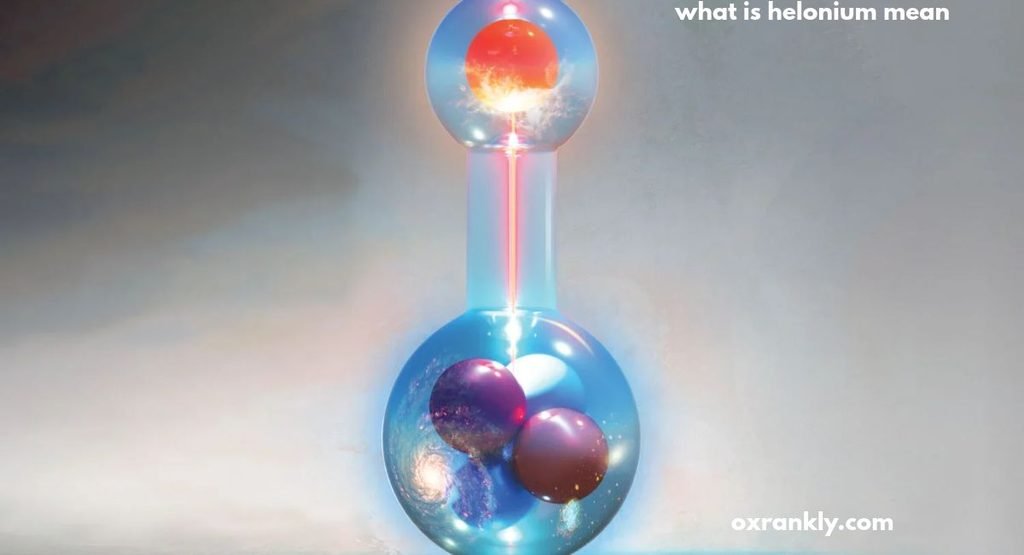
When helium and a hydrogen nucleus combine, they can form the helium hydride ion. The resulting particle has a positive electrical charge, which is why its chemical formula includes a plus sign.
In simple words, helonium is connected to a tiny chemical structure made from helium and hydrogen. It is especially important because of its role in understanding how chemistry developed in the early universe.
The name may look like an ordinary element name, but that interpretation is incorrect. Helonium is not a newly discovered element or a substance with its own atomic number. It is a molecular ion with a specific chemical identity.
Understanding the Chemical Formula of Helonium
The chemical formula of helonium is HeH⁺. Although this formula contains only a few characters, each part provides important information about its structure.
The letters represent the chemical elements involved, while the positive sign indicates the electrical charge of the resulting ion.
Here is a simple breakdown:
- He: Represents helium.
- H: Represents hydrogen.
- + : Indicates that the molecular ion has a positive electrical charge.
Helium normally has two protons and two electrons. A hydrogen nucleus in this particular reaction contributes one proton. When the helium atom combines with that proton, the resulting HeH⁺ ion contains three protons and two electrons.
Because it has one more positive charge than negative charge, the overall particle carries a positive charge.
This is an important distinction because chemical formulas communicate more than the names of the elements involved. They also explain how atoms and ions are connected and whether an electrical charge is present.
Understanding the formula makes the meaning of helonium much easier to recognize in chemistry textbooks, astronomy discussions, and scientific articles.
Is Helonium a Real Chemical Element
One common question about helonium is whether it is a real chemical element. The answer is no. Helonium is not an independently recognized element on the periodic table.
The periodic table contains chemical elements arranged according to their atomic numbers. Every element has a unique number of protons in its nucleus. For example, hydrogen has atomic number one, while helium has atomic number two.
Helonium does not have its own atomic number because it is not a separate element. Instead, it is an ion made from helium and hydrogen.
This distinction is important because the names of chemical substances can sometimes create confusion. Many scientific names end in similar combinations of letters, but that does not mean they all represent individual elements.
For example, water contains hydrogen and oxygen, but water is not a chemical element. Similarly, the helium hydride ion contains components from two elements without becoming a new element itself.
Therefore, when someone asks what is helonium mean, the most accurate scientific explanation is that it refers to the helium hydride ion rather than a new entry on the periodic table.
How Is Helonium Formed
Helonium forms through a chemical interaction between helium and a hydrogen nucleus. This process is particularly interesting because helium is normally considered a very unreactive element.
Helium belongs to a group of elements called noble gases. These gases generally have stable electron arrangements, making them less likely to participate in ordinary chemical reactions.
However, under suitable conditions, helium can interact with a positively charged hydrogen nucleus. This interaction produces the helium hydride ion, HeH⁺.
The formation of this ion demonstrates that even elements known for their chemical stability can participate in certain unusual reactions.
In the early universe, conditions were very different from those found on Earth today. Temperatures, radiation levels, and the availability of different particles influenced how the first chemical substances formed.
As the universe expanded and cooled after the Big Bang, the formation of simple ions and molecules became possible. Helium hydride is considered an important part of this early chemical history.
Scientists study these processes to understand how the universe gradually developed from a collection of basic particles into a much more chemically diverse environment.
The Connection Between Helonium and the Early Universe
One of the most fascinating aspects of helonium is its relationship with the early universe.
After the Big Bang, the universe was extremely hot and filled with energetic particles. During this early period, stable atoms and molecules could not form easily because the surrounding conditions were too energetic.
As the universe expanded, it gradually cooled. This allowed electrons and atomic nuclei to combine, creating the first neutral atoms.
Hydrogen and helium became two of the most important elements in the early universe. Once suitable conditions developed, chemical reactions between these particles helped create the first molecules.
Helium hydride ions are particularly interesting because researchers believe they were among the earliest molecular species to form.
Their formation represented an important stage in the development of chemistry. Before complex molecules could exist, simpler chemical structures needed to develop first.
Helonium therefore provides scientists with an opportunity to investigate the earliest stages of molecular chemistry.
It also helps explain how the universe gradually moved from simple atomic structures toward more complicated chemical systems.
Why Is Helonium Considered Important in Science
Helonium is important because it helps scientists understand the development of chemical reactions in environments that existed billions of years ago.
Although HeH⁺ is a very small molecular ion, its scientific significance is much greater than its size might suggest.
There are several reasons researchers find it interesting.
1. Understanding early chemical development
Helium hydride provides clues about how the first molecules formed after the Big Bang. Studying it helps researchers investigate the earliest stages of chemistry.
2. Understanding molecular reactions
Scientists can examine how helium and hydrogen interact under different physical conditions. These reactions help improve scientific knowledge of molecular formation.
3. Studying astronomical environments
Helium hydride can exist in certain astronomical environments, including regions containing hot ionized gas. Observing it provides information about the physical and chemical conditions in space.
4. Improving scientific models
Researchers use laboratory experiments and astronomical observations to test theories about how molecules form and behave.
5. Exploring the history of the universe
The study of early molecular chemistry helps scientists understand how the universe developed its chemical complexity over time.
These points demonstrate why a molecule containing only two atomic components can be so valuable to modern scientific research.
When Was Helonium First Discovered
The history of helium hydride research goes back several decades.
Scientists first produced and identified the helium hydride ion in laboratory experiments in 1925. This was an important achievement because it demonstrated that helium could form a stable molecular ion under suitable experimental conditions.
However, detecting a molecule in a laboratory is different from finding it in outer space.
For many years, astronomers believed that helium hydride should exist in certain astronomical environments, especially those containing hot gas and ionized particles. Nevertheless, confirming its presence in space proved difficult.
The challenge was partly related to the wavelengths of light associated with the molecule. Astronomers needed suitable instruments capable of identifying its characteristic signals among other emissions.
Eventually, technological developments made it possible to investigate this question more effectively.
The discovery process became an important chapter in the study of astronomical chemistry, connecting laboratory research with observations of distant objects.
The First Confirmed Detection of Helonium in Space
One of the biggest milestones in helium hydride research occurred in 2019.
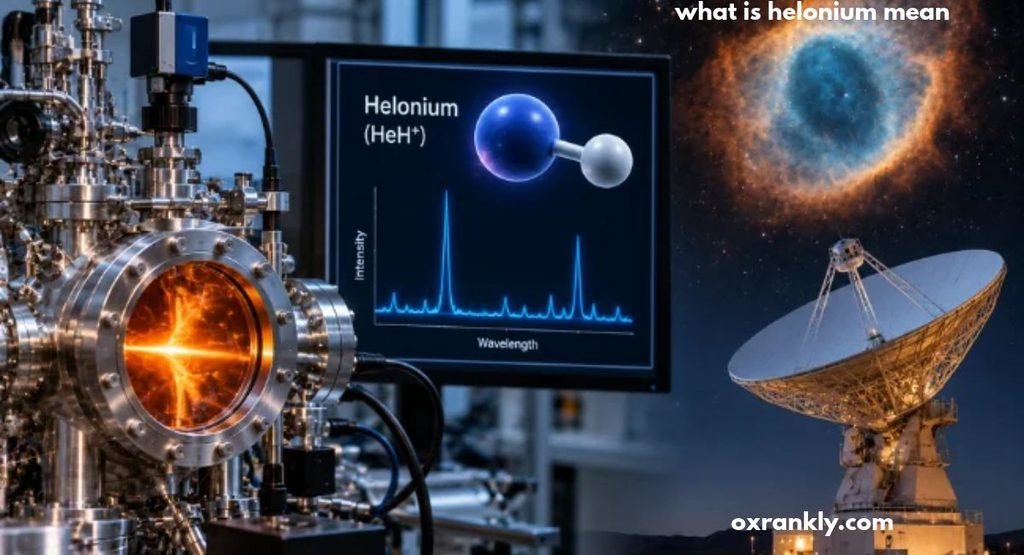
Astronomers announced the first confirmed detection of the helium hydride ion in space. They identified it in a planetary nebula called NGC 7027.
The observation was made using NASA’s Stratospheric Observatory for Infrared Astronomy, commonly known as SOFIA.
SOFIA was an airborne observatory that carried an infrared telescope aboard a specially modified aircraft. Its ability to observe infrared radiation helped researchers investigate molecules that were difficult to identify using conventional ground-based observations.
The detection was important because helium hydride had been predicted to exist in space for many years.
Finding it provided valuable evidence supporting scientific models of molecular chemistry in astronomical environments.
It also demonstrated how improvements in astronomical instruments can help scientists answer questions that previously remained unresolved.
The 2019 observation was particularly meaningful because it connected the theoretical importance of early-universe chemistry with a real astronomical detection.
What Is the Difference Between Helonium and Helium
Helonium and helium are related, but they are not the same thing.
Helium is a chemical element with the symbol He and atomic number two. It is a noble gas commonly used in balloons, scientific equipment, and certain industrial applications.
Helonium, in the relevant scientific usage, refers to the helium hydride ion, HeH⁺. It contains helium and hydrogen and carries a positive electrical charge.
The main differences can be understood through their chemical structures.
| Feature | Helium | Helonium |
|---|---|---|
| Chemical identity | Element | Molecular ion |
| Symbol or formula | He | HeH⁺ |
| Components | Helium | Helium and hydrogen |
| Electrical charge | Neutral atom | Positive charge |
| Periodic table | Yes | No |
| Scientific importance | Many applications | Molecular and astronomical research |
The most important difference is that helium is an individual chemical element, whereas helonium represents a combination of atomic components.
Knowing this difference prevents confusion when reading scientific explanations.
Is Helonium the Same as Hydrogen
No, helonium is not the same as hydrogen.
Hydrogen is a chemical element with the symbol H and atomic number one. It is the most abundant element in the universe and is an essential component of stars, water, and countless chemical substances.
Helonium involves hydrogen as one of its components, but it also includes helium.
The hydrogen component in HeH⁺ is represented by a proton. This proton interacts with a helium atom, producing a positively charged molecular ion.
Hydrogen can exist in several forms, including neutral atoms, positively charged ions, and molecules. Its chemical behaviour depends on the surrounding conditions and the particles with which it interacts.
Helonium is one example of how hydrogen participates in more unusual chemical structures.
Understanding the difference between the two helps explain why the helium hydride ion has its own scientific identity.
Where Can Helonium Be Found
Helonium is mainly discussed in scientific research involving molecular chemistry and astronomy.
Unlike ordinary helium, which can be collected and used in various applications on Earth, helium hydride ions are associated with particular physical environments.
One important location where researchers have detected HeH⁺ is the planetary nebula NGC 7027.
Planetary nebulae are astronomical structures formed during certain late stages of stellar evolution. They contain gas and dust released by stars as they change over time.
These environments can have conditions that allow unusual chemical reactions to occur.
Helium hydride ions may also be relevant to the study of early-universe chemistry, where scientists investigate how the first molecular species developed.
However, it is important not to assume that helonium is a common substance found everywhere in space. Its formation depends on specific physical and chemical conditions.
Research into its distribution and behaviour helps astronomers better understand the chemistry of different astronomical environments.
Does Helonium Have Practical Uses
Helonium is not a common commercial material used in everyday products.
Its primary importance is scientific rather than industrial. Researchers study it to investigate chemical reactions, molecular structures, and astronomical processes.
Unlike helium, which has practical applications in medicine, manufacturing, scientific instruments, and other industries, helium hydride ions are generally discussed in specialized research.
Its usefulness comes from the information it provides rather than from its everyday commercial applications.
For example, studying HeH⁺ can help researchers understand how molecules form in environments with extreme temperatures and unusual chemical conditions.
It can also help astronomers interpret observations of distant astronomical objects.
Although helonium does not have the same practical uses as ordinary helium, its scientific importance should not be underestimated.
Small molecular ions can provide valuable information about much larger questions concerning the history and development of the universe.
Why Does the Name Helonium Sound Like an Element
The name helonium can easily create confusion because it resembles the names of chemical elements.
Words such as helium, lithium, sodium, titanium, and uranium have familiar scientific naming patterns.
When people see helonium for the first time, they may naturally assume that it belongs to the same category.
However, chemical naming conventions include different types of substances, ions, and molecular structures.
The ending of a scientific name does not automatically tell someone whether the substance is an element, compound, or ion.
In this case, helonium is associated with the helium hydride ion rather than a separate chemical element.
This is why understanding the chemical formula HeH⁺ is more useful than relying only on the appearance of the word.
It shows that the term is connected to helium and hydrogen and identifies the positive charge of the resulting molecular ion.
How Do Scientists Study Helonium
Scientists use several research methods to investigate helium hydride ions. These methods include laboratory experiments, spectroscopy, mathematical calculations, and astronomical observations.
Each method provides a different type of information.
Laboratory Experiments
In laboratories, researchers can create controlled conditions to study how helium and hydrogen interact.
They examine the formation of HeH⁺ and measure its physical and chemical properties. These experiments help scientists understand how the ion behaves and how it responds to different conditions.
Spectroscopy
Spectroscopy is an important scientific technique used to study the interaction between matter and electromagnetic radiation.
Molecules and ions can produce or absorb light at particular frequencies. Scientists examine these signals to identify chemical substances and learn about their properties.
This technique was particularly important in the astronomical detection of helium hydride.
Computer Simulations
Computer models allow researchers to investigate chemical reactions that may be difficult to reproduce under ordinary laboratory conditions.
Scientists can use calculations to understand molecular structures, reaction rates, and the behaviour of ions in different environments.
Astronomical Observations
Astronomers use specialized telescopes and instruments to examine radiation coming from distant objects.
These observations can reveal the presence of different molecules and help researchers understand the chemistry of space.
Combining these methods provides a more complete understanding of helonium and its scientific importance.
Common Misunderstandings About Helonium
Because helonium is an unusual scientific term, people sometimes misunderstand its meaning.
Here are some common misconceptions worth correcting.
Misunderstanding 1: Helonium is a new chemical element.
This is incorrect. Helonium is associated with the helium hydride ion, HeH⁺. It does not have its own atomic number or periodic-table position.
Misunderstanding 2: Helonium and helium are identical.
They are different. Helium is a neutral chemical element, while HeH⁺ is a positively charged molecular ion containing helium and hydrogen.
Misunderstanding 3: Helonium is an ordinary gas used in balloons.
Ordinary helium is used in balloons and several industrial applications. Helonium should not be confused with commercially available helium gas.
Misunderstanding 4: Helonium was discovered in space for the first time in 1925.
The year 1925 refers to its laboratory identification. Its first confirmed astronomical detection was announced in 2019.
Misunderstanding 5: Helonium is a fictional substance.
Although the word might sound fictional, helium hydride is a genuine scientific species. Its existence has been investigated through laboratory experiments and astronomical observations.
Understanding these differences makes it easier to separate scientific facts from incorrect explanations.
Why Are People Interested in What Is Helonium Mean
People search for unusual scientific terms for different reasons. Sometimes they encounter an unfamiliar word in an article, educational discussion, search result, or scientific explanation.
The question what is helonium mean may come from curiosity about chemistry, astronomy, or the history of the universe.
The unusual spelling also makes the term interesting. It resembles the name of an element, which encourages people to investigate whether it represents a newly discovered substance.
Another reason is the connection between helium hydride and the early universe. The idea that scientists can study a tiny molecular ion to understand events that happened billions of years ago is fascinating.
Students may also encounter the term while learning about atomic structures, molecular ions, and chemical reactions.
Whatever the reason for searching, understanding the basic definition provides a useful starting point for exploring the subject in greater detail.
How Can You Use Helonium in a Sentence
Since helonium is a specialized scientific term, it is generally used in discussions about chemistry, astronomy, and molecular research.
Here are some simple examples:
- Scientists studied helonium to understand the formation of early molecular structures in the universe.
- Helonium is associated with the helium hydride ion, which has the formula HeH⁺.
- The discovery of helium hydride in space provided important evidence for astronomical chemistry.
- Researchers examined helonium using spectroscopy and laboratory experiments.
- Students learned about helonium while studying the chemical interactions between helium and hydrogen.
These examples show how the term can be used in educational and scientific conversations.
What Makes Helonium Different From Other Molecular Ions
Molecular ions are groups of atoms that are connected through chemical interactions and carry an electrical charge.
Helonium is interesting because it contains helium, an element that is normally very reluctant to form chemical bonds.
Many familiar molecular ions contain elements that readily participate in chemical reactions. Helium behaves differently because of its stable electron arrangement.
The formation of HeH⁺ demonstrates that unusual chemical structures can exist under the right conditions.
Another interesting feature is its connection to the early universe. Researchers consider helium hydride important when studying how the first molecular structures developed.
Its simple composition also makes it useful for investigating fundamental questions about chemical bonding.
Although it is not the only molecular ion studied by scientists, its unusual properties and astronomical importance make it a particularly interesting subject.
The Future of Helonium Research
Scientific research into helium hydride continues to contribute to our understanding of molecular chemistry and astronomical environments.
Future observations and improved instruments may help researchers investigate where HeH⁺ forms, how it behaves, and how its abundance changes under different conditions.
Better telescopes could also provide more information about the chemical composition of distant astronomical objects.
Laboratory experiments will remain important because they allow scientists to compare real measurements with theoretical predictions.
Computer simulations may further improve our understanding of the reactions that occur in environments that are difficult to reproduce on Earth.
Another important area of research involves understanding how different molecules contribute to the development of more complex chemical systems.
As scientific technology improves, researchers may discover additional information about the role of simple ions in the history of the universe.
Helonium is a useful example of how studying something extremely small can contribute to answering some of the biggest questions in science.
Frequently Asked Questions About Helonium
What is helonium mean in simple words
Helonium refers to the helium hydride ion, HeH⁺. It is a positively charged molecular ion made from helium and hydrogen. It is particularly interesting because of its connection to the early chemical development of the universe.
Is helonium a real word
Yes. Helonium is used as a scientific term associated with helium hydride. It is not a common everyday English word, so people may encounter it mainly in chemistry and astronomy discussions.
What is the chemical formula of helonium
The chemical formula is HeH⁺. The symbol He represents helium, H represents hydrogen, and the plus sign indicates a positive electrical charge.
Is helonium found on the periodic table
No. Helonium is not an independent chemical element and therefore does not have its own position on the periodic table. It is a molecular ion formed from two chemical components.
When was helonium discovered
The helium hydride ion was first identified in laboratory experiments in 1925. Its first confirmed detection in space was announced in 2019.
Why is helonium important
Helonium is important because it helps scientists understand early-universe chemistry, molecular formation, and the chemical interactions that occur in astronomical environments.
Is helonium the same as helium gas
No. Helium gas consists of neutral helium atoms, while helonium refers to the positively charged helium hydride ion, HeH⁺. Their chemical structures and properties are different.
Can helonium be used in everyday life
Helonium does not have widespread everyday commercial applications. Its main importance is in scientific research, particularly chemistry and astronomy.
Why is helonium connected to the Big Bang
Scientists believe helium hydride ions were among the earliest molecular species to form after the Big Bang. Studying them helps researchers understand how the first chemical bonds developed as the universe cooled.
Is helonium dangerous
The scientific term helonium refers to a molecular ion studied under specialized conditions. It should not be confused with ordinary helium gas or treated as a consumer product. Its scientific description alone does not establish a practical safety profile for handling it.
Conclusion
Understanding what is helonium mean becomes much easier when you look at its scientific meaning and chemical structure. Helonium is associated with the helium hydride ion, represented by the formula HeH⁺. It is a positively charged molecular ion containing helium and hydrogen rather than a separate chemical element.
Its importance comes from its connection to the earliest stages of molecular chemistry in the universe. Scientists have studied this unusual ion to understand how the first chemical bonds formed and how simple atomic structures gradually developed into more complex molecules.
The identification of helium hydride in laboratory experiments in 1925 and its first confirmed detection in space in 2019 were important milestones in scientific research.
Although helonium is not a substance commonly encountered in everyday life, it provides valuable information about chemistry, astronomy, and the history of the universe.
Ultimately, helonium demonstrates that even the smallest molecular structures can help scientists investigate enormous questions about how our universe began and developed. By continuing to study helium hydride, researchers can improve their understanding of chemical reactions and the fascinating processes that take place throughout space.